Case studies · 23 November 2026 · 8 min read
The Parent's Guide to the IB Diploma: Understanding Predicted Grades, IAs, and the Core
By IB Meridian Educationists
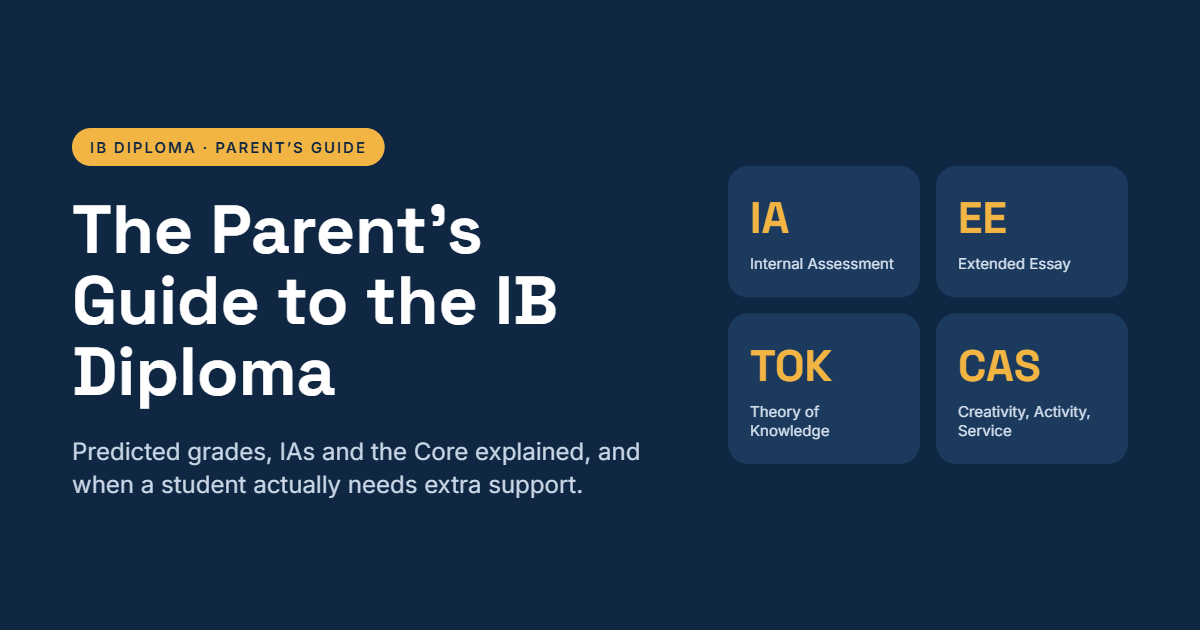
If your child has just started the IB Diploma Programme (DP), you have probably already met a wall of acronyms: IA, EE, TOK, CAS, HL, SL. Your son or daughter may be using them casually at the dinner table while you nod along and quietly search for them later. This guide is for you. It explains how the Diploma fits together, what predicted grades really are, why internal assessments matter so much, and how to tell the difference between a student who is working through normal pressure and one who would genuinely benefit from outside help. The Diploma in one paragraph The IB Diploma is a two-year programme, usually taken at ages 16 to 18. Students study six subjects, one from each of six groups (language and literature, language acquisition, individuals and societies, sciences, mathematics, and the arts or a second choice from another group). Three or four of these are taken at Higher Level (HL) and the rest at Standard Level (SL). HL goes into more depth and breadth. Alongside the six subjects sits the Core, which we will come to shortly. Each subject is graded from 1 to 7, so the six subjects give a maximum of 42 points. The Core can add up to 3 bonus points, for a total of 45. The IB sets a minimum total for the diploma to be awarded (24 points) along with several other conditions, so it is worth checking the current rules on the IB's website or with your school's coordinator rather than relying on a summary. Decoding the jargon Predicted grades A predicted grade is your child's teacher's professional judgement of the grade the student is likely to achieve in the final exams in each subject. Schools submit these during the second year, and universities use them heavily when making conditional offers. A university might offer a place on the basis of, say, 36 points, and the predicted grades are what they look at while waiting for the real results. A few things parents often misunderstand: • A predicted grade is not a guarantee, and it is not a target. It is a considered estimate based on evidence such as classwork, mock exams, internal assessments, and the student's trajectory. • It is not a threat or a reward. A teacher who predicts conservatively is usually trying to be accurate, not unkind. • It can change. Students who improve, or who slip, may see predictions adjusted as the evidence changes. • Teachers are usually cautious about inflating them. Schools have a reputation to protect with universities, so predictions tend to be realistic. If you are worried about a prediction, the best move is to ask the teacher what evidence it rests on and what the student could do to strengthen it. That is a far more useful conversation than debating the number itself. Internal Assessments (IAs) The IA is a piece of coursework completed during the programme. It might be a lab investigation in a science, a mathematical exploration, an oral in a language, a piece of research in the humanities, or a software project in computer science. IAs are marked by the student's own teacher and then a sample is checked by an external moderator from the IB. In most subjects the IA is worth roughly 20 to 30 percent of the final subject grade (it varies, so check the specific subject guide), which means it can meaningfully move a student up or down a grade boundary. Why IAs matter beyond the percentage: • They are completed before the final exams, so they are marks already in the bank. • They reward sustained, independent work, which is very different from exam skills. • They are where students most often run into trouble with time management, because the deadlines overlap with everything else. A frequent concern from parents is how much help is appropriate. The IB has strict rules on academic integrity. Support should help a student understand and improve their own work, never produce it for them. A good teacher, tutor, or parent asks questions, points out where the criteria are not being met, and lets the student do the writing and the thinking. The Core: Extended Essay, TOK and CAS The Core is what makes the Diploma distinctive. It has three parts. The Extended Essay (EE) is an independent research paper of up to 4,000 words on a topic of the student's choice, usually within one of their subjects. It is closer to a university-style dissertation than anything most students have written before. Students are assigned a supervisor at school, but the project is largely self-directed over many months. Theory of Knowledge (TOK) is a course that asks how we know what we know. It is assessed through an exhibition (students connect objects to real-world contexts) and a 1,600-word essay on a prescribed title. Many students find it abstract at first, and it often feels unlike any other class. Creativity, Activity, Service (CAS) is a requirement rather than an exam. Students take part in experiences across the three strands over roughly 18 months and reflect on them. CAS is not graded, but it must be completed for the diploma to be awarded. It is the one part of the Core where doing nothing can cost a student the whole diploma. The EE and TOK are graded from A to E, and together they can contribute up to 3 bonus points. An E in either one is a failing condition for the diploma, so they are not optional extras. The rhythm of the two years It helps to know roughly what the pressure points look like, because most difficulties are predictable. • Early in Year 1: a big adjustment in workload, and the first experience of IB-style assessment criteria. • Late Year 1 into Year 2: IA and EE deadlines begin to stack up, and this is where many students feel the squeeze. • Year 2, first half: university applications, predicted grades, and mock exams all arrive at once. • Year 2, second half: revision, final exams, and the long wait for results. Knowing this, you can anticipate the stressful stretches instead of being surprised by them. When does a student actually need external support? Not every struggling student needs a tutor, and not every high-achieving student is fine. Support is most useful when it targets a specific problem. Here are the signals worth paying attention to. Signs that support could genuinely help • A persistent gap between effort and results. The student is working hard but the grades are not moving, which often points to a skills or understanding gap rather than a motivation problem. • Confusion about the assessment criteria. IB marking is criteria-based, and many students lose marks not because they lack knowledge but because they have not understood what the examiner is looking for. • Foundation gaps in a cumulative subject. Maths, sciences, and computer science build on earlier material. A shaky foundation tends to get more expensive the longer it is left. • IA or EE drift. The student keeps pushing the work back, has no clear plan, or is stuck at the same stage for weeks. • A subject-specific wall. One subject is dragging while the others are fine, especially at HL, where the jump in difficulty can be steep. • Teaching changes. A change of teacher, a long absence, or a move between schools or curricula can leave real gaps that the class has not paused to fill. • Targeting a specific university requirement. If a course demands a particular grade in a particular subject, focused help on that subject can be a sensible investment. Signs that support is probably not the first answer • The student is exhausted and overcommitted. More tutoring on top of an overloaded schedule often makes things worse, and the better move might be to cut something. • The grades are fine, but the student or parent is anxious. A conversation with the teacher or the IB coordinator may settle the worry for free. • The issue is wellbeing, not academics. Sleep, stress, and mental health come first, and the school counsellor is usually the right starting point. • The student does not want help. Support works much better when the student sees the point of it. A simple test Before booking anything, ask three questions:
- What exactly is the problem? (A specific topic, a skill, a deadline habit, or a general feeling?)
- Have we talked to the teacher? They often know precisely where the gap is.
- What would success look like in six weeks? If you cannot describe it, the support probably is not targeted enough yet.
What good support looks like Whether it comes from a school teacher, a tutor, or a study group, effective IB support tends to share a few traits: • It is aligned to the IB criteria and the subject guide, not generic homework help. • It builds the student's independence instead of creating dependence. • It respects academic integrity: guiding, questioning, and giving feedback, but never writing the work. • It is targeted and time-limited, with a clear goal that can be reviewed. • It keeps the student's wellbeing in view, not just their marks. How parents can help at home You do not need to understand the content to make a real difference. • Learn the vocabulary. Just knowing what IA, EE, TOK, CAS, HL and SL mean makes conversations easier. • Ask about the plan, not just the grade. "What are your next three deadlines?" is more useful than "How did you do?" • Protect sleep and downtime. A rested student learns faster than a sleep-deprived one. • Keep a calendar visible. IA, EE, and CAS deadlines are where most avoidable stress comes from. • Stay in touch with the school. The IB coordinator and subject teachers are your best sources of accurate information. • Keep perspective. The Diploma is demanding, but it is one stage of a long road. A student who finishes with their health and curiosity intact is in a strong position. Final thoughts The IB Diploma looks intimidating from the outside, mostly because of the jargon. Once you understand the structure (six subjects, a Core, internal and external assessment, and predicted grades as a bridge to university), it becomes much easier to see where your child is, what comes next, and when a little extra help could make a real difference. If you are unsure whether your child would benefit from support, start by talking to their teachers and to your child. The right answer is usually clearer than it first appears.
Push Your IA or Extended Essay to Grade A / 7
Receive line-by-line examiner annotations, Criterion A–E rubric scoring, and structured guidance before school deadlines.